English Translation of Power Equipment Documentation: A Localization Guide for Transformers, Switchgear, and Primary Equipment
A technical guide to translating power equipment documentation—transformers, switchgear, and primary equipment—covering terminology standardization, IEC compliance, and practical QA checklists for global EPC projects.
Introduction: Translating Power Equipment Is an Engineering Challenge, Not Just a Language Task
In power equipment export and overseas EPC projects, the English documentation for transformers, switchgear, and primary equipment directly affects bid responses, owner approvals, and on-site commissioning. A single mistranslated nameplate parameter, protection setting, or installation instruction can lead to equipment rejection, schedule delays, or even safety incidents. The core of English translation for power equipment documentation is not word-for-word correspondence but engineering semantic equivalence—ensuring zero ambiguity in technical parameters, operating logic, and safety warnings under the IEC standards framework and target-market regulations.
1. Three Technical Challenges in Power Equipment Documentation Translation
1.1 Complex Terminology Under Strict Standards
Primary equipment such as transformers and switchgear involves multidisciplinary terms from electromagnetics, insulation, mechanics, and control. The same Chinese term may have different English equivalents depending on context. For example, “额定电压” is rated voltage on a transformer nameplate but may relate to highest voltage for equipment (IEC 60071) in insulation coordination. Without a terminology database, inconsistency within a single document is almost inevitable.
1.2 Mixed Layout of Drawings, Tables, and Formulas
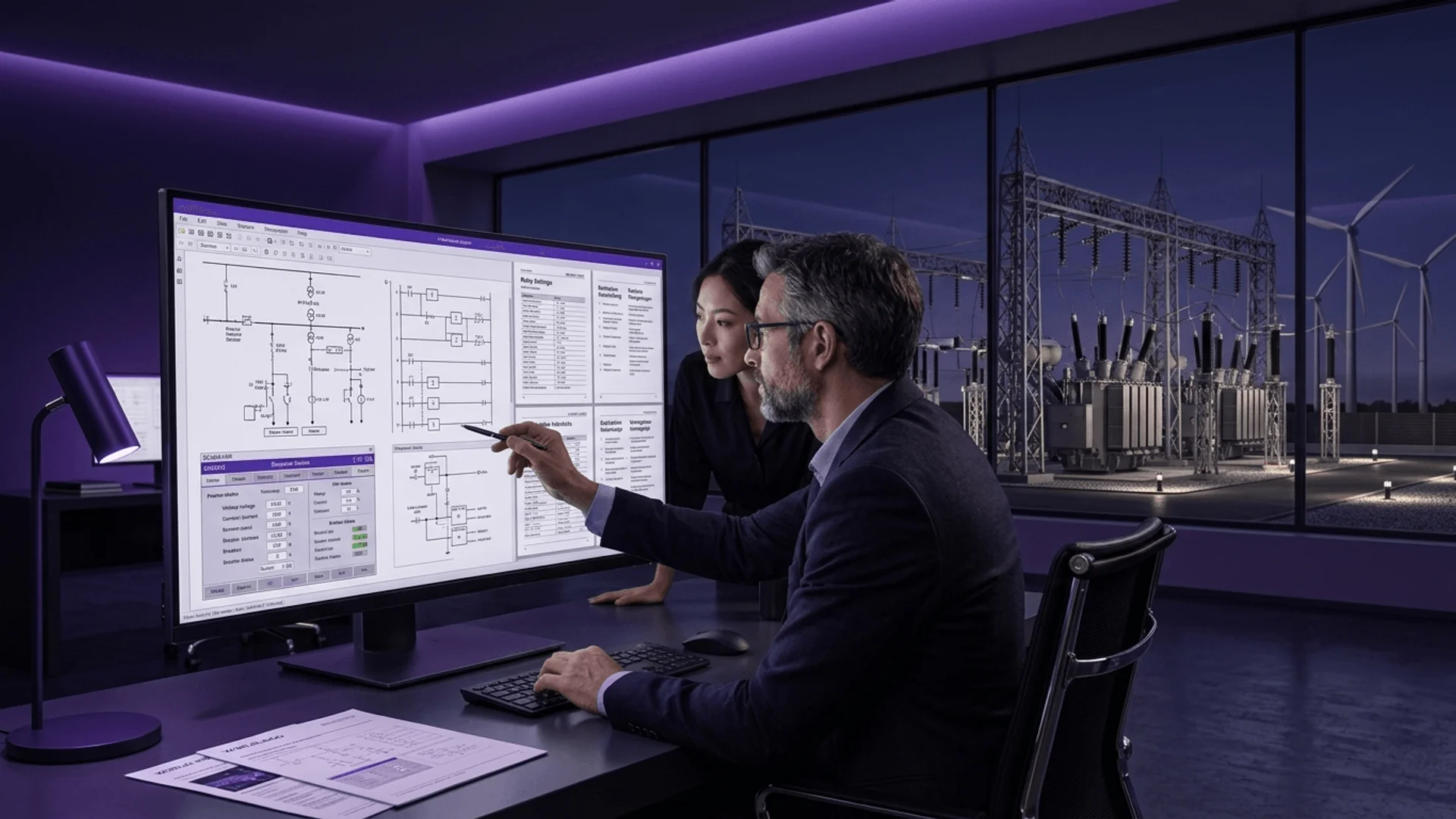
Power equipment documentation often includes single-line diagrams, terminal block diagrams, characteristic curves, and parameter tables. Translation must preserve table structures, unit symbols (e.g., kV, MVA, kA), and graphical annotations, avoiding symbol loss due to font or encoding issues.
1.3 Non-Negotiable Safety and Compliance Language
The “five prevention” interlocking in switchgear operating instructions and the operating sequence of earthing switches must use expressions recognized by the target market. For CE, UKCA, or North American markets, terminology must also align with the Low Voltage Directive (LVD), EMC Directive, and other regulatory frameworks.
2. Comparison of Key Translation Points by Equipment Type
| Equipment Type | Typical Documents | Key Translation Points | Common Risks |
|---|---|---|---|
| Transformer | Nameplate, test reports, temperature-rise calculation | Capacity/voltage ratio, vector group (e.g., Dyn11), impedance voltage | Misinterpreted vector group causing parallel operation failure |
| Switchgear | Operating instructions, interlocking logic diagrams, type test reports | Five-prevention interlocking, circuit breaker open/close, earthing switch | Ambiguous operating sequence leading to misoperation |
| Primary Equipment | Installation drawings, busbar layout, insulation coordination | Safety clearance, creepage distance, altitude correction | Unit conversion errors causing insufficient insulation margin |
3. Actionable Translation and Review Checklist
- Establish a project-level terminology database to lock down English equivalents for core terms in transformers, switchgear, and primary equipment.
- Verify IEC standard reference numbers and years against the current versions in the target market.
- Check the display integrity of unit symbols, superscripts/subscripts, and special characters in PDF/DOC.
- Perform back-translation validation on safety warnings to confirm zero ambiguity.
- Conduct technical review by reviewers with a power engineering background.
Key Terminology Cross-Reference
| English | Chinese | Definition |
|---|---|---|
| Transformer | 变压器 | A static electrical device that changes AC voltage and current via electromagnetic induction. |
| Switchgear | 开关柜 | A combination of electrical equipment used for generation, transmission, distribution, and conversion of electric energy. |
| Primary Equipment | 一次设备 | Electrical equipment directly involved in the production, conversion, transmission, and distribution of electric energy. |
| Rated Voltage | 额定电压 | The voltage value on which equipment design is based, defining insulation level and operating conditions. |
| Vector Group | 联结组标号 | A designation indicating the connection and phase relationship of transformer windings, e.g., Dyn11. |
| Creepage Distance | 爬电距离 | The shortest distance along an insulating surface between two conductive parts. |
| Interlocking | 联锁 | Mechanical or electrical constraints designed to prevent misoperation. |
Frequently Asked Questions (FAQ)
Q1: What should be noted when translating the vector group on a transformer nameplate?
A1: The vector group designation (e.g., Dyn11) is an internationally recognized code and is generally not translated. However, the case, letter order, and digits must be accurate. If the Chinese document says “Dyn11,” the English document must remain identical—never rewrite it as “Dyn-11” or “dYN11”—otherwise the owner may treat it as a technical deviation.
Q2: How should the “five prevention” of switchgear be accurately expressed in English?
A2: “Five prevention” is typically translated as five prevention interlocking or five-proof interlocking, with a note on first occurrence: preventing misoperation of circuit breakers, preventing load-breaking operation of disconnectors, preventing live earthing, preventing earthing switch closing on live circuits, and preventing entry into live compartments. It is recommended to list each item in the operating instructions rather than using only the abbreviated term.
Q3: Does English translation of primary equipment documentation need to comply with specific standards?
A3: Yes. English documentation for power equipment typically needs to comply with IEC 60050 (International Electrotechnical Vocabulary), IEC 62271 (high-voltage switchgear), and other standard terminology systems. For the North American market, IEEE C37 series and ANSI standards also apply. Translation providers should have a power engineering background and follow ISO 17100:2015 processes for translation, review, and final verification.
Conclusion: Driving Globalization of Power Equipment with Engineering Rigor
English translation of power equipment documentation is an interdisciplinary engineering task spanning technology, standards, and language. Building terminology databases, conducting bilingual reviews, and following IEC and target-market regulations are key to reducing export risks. If you are preparing English technical documentation for transformers, switchgear, or primary equipment, contact Linguist for a professional assessment and quote. We deliver traceable localization based on ISO 17100-certified processes.
Expanding globally or tackling translation compliance?
ISO 17100 certified. Get instant localization readiness diagnostic & quotation.
Share this article