
Medical Device Technical Specification Translation: Precision from Specs to Compliance
Technical specification translation in medical devices is a compliance-critical task. This article examines terminology consistency, regulatory alignment, and engineering best practices for specs, standards, and IFUs.

Why Technical Specification Translation in Medical Devices Leaves No Room for Error
A single mistranslation in a technical specification can delay CE certification by months or trigger an FDA 510(k) deficiency letter. This isn't fear-mongering. Technical specification translation in medical devices goes far beyond language conversion—it directly impacts the evidence chain for compliance with EU MDR 2017/745 and IVDR 2017/746.
I once reviewed a glucose meter's technical standard translation where "accuracy" was consistently rendered as "准确度" in Chinese, but the clinical evaluation report mixed "精确度" and "精密度." The notified body flagged this as a nonconformity. The lesson is blunt: specification translation demands a locked terminology database and strict enforcement.
Three Core Challenges in Technical Specification Translation
1. Terminology Consistency: From Design Input to Risk Management
Medical device specifications are dense with specialized terms like "sterile barrier system," "biocompatibility," and "worst-case scenario." Translations must align perfectly with the quality management system (ISO 13485) and risk management file (ISO 14971). We typically ask clients to provide a corporate glossary upfront, or we extract candidate terms from legacy documents for client approval before locking them in.
2. Regulatory Alignment: MDR/IVDR Language Requirements for Technical Documentation
EU MDR Annex II requires technical documentation to include "a description of the device and its intended use," and the language must be an official language of the member state. For specification translation, notified bodies scrutinize:
- Whether performance parameter units and tolerances match the original test reports
- Whether chemical names in the bill of materials follow IUPAC nomenclature or pharmacopeia standards
- Whether referenced standards (e.g., IEC 60601-1) cite the correct version
A common error: writing "ISO 10993-1:2009" instead of "ISO 10993-1:2018," which raises questions about the biocompatibility evaluation.
3. Format and Readability: From Engineering Drawings to IFUs
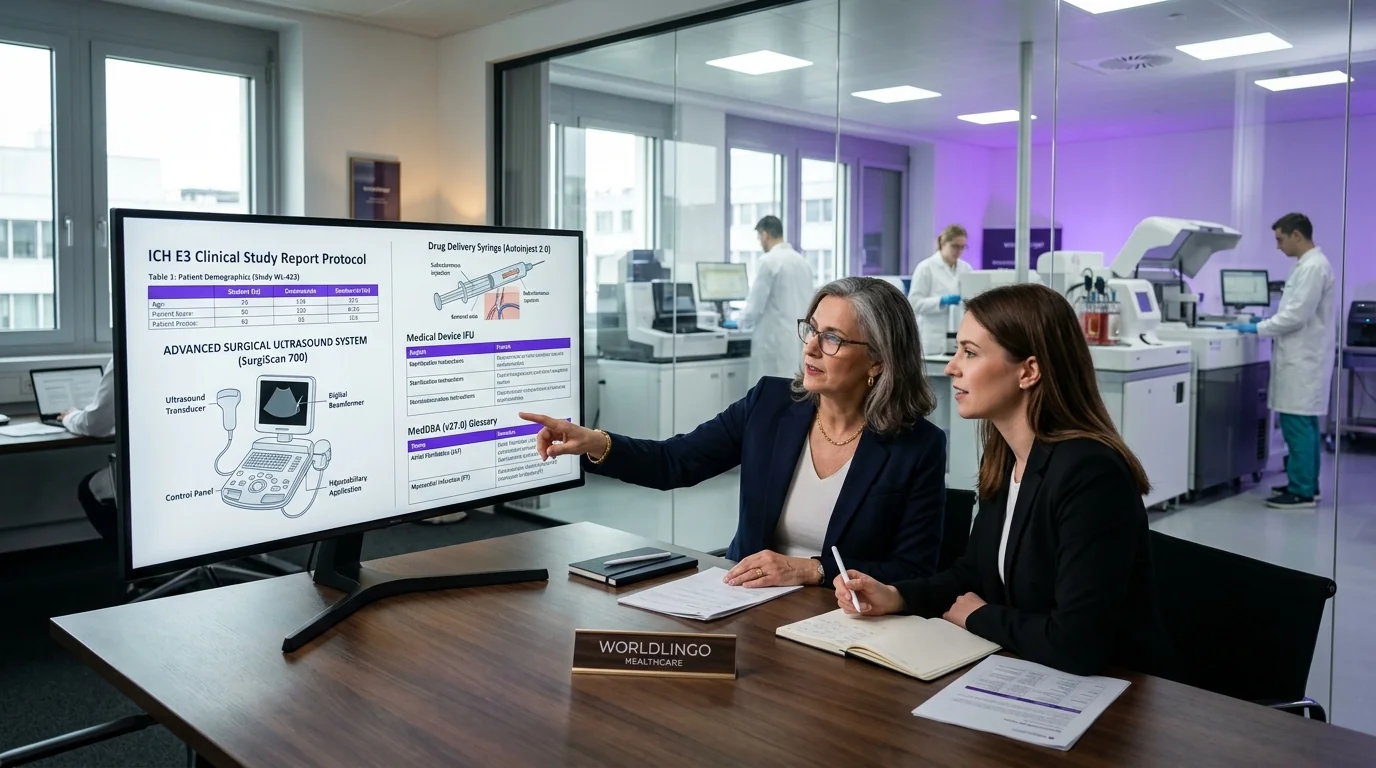
Technical specification translation often involves tables, drawing callouts, and flowcharts. We handled an orthopedic implant specification where the original used Visio-drawn tolerance tables. The translation had to preserve layout and ensure Chinese labels didn't overflow. This requires desktop publishing (DTP) capability and familiarity with text extraction from CAD drawings.
An Engineered Workflow for Specification Translation
Based on ISO 17100:2015, our workflow for medical device clients is as follows:
- Project preparation: Extract terminology, analyze document structure, confirm reference standards list
- Translation: Performed by translators with medical or engineering backgrounds, using Trados or memoQ for consistency
- Technical review: A senior engineer in the target language reviews technical accuracy (not just language)
- Regulatory review: Check compliance with MDR/IVDR documentation phrasing requirements
- DTP and verification: Restore formatting, final QA for numbers, units, and cross-references
The technical review step is the most overlooked. Many agencies only do language review, but whether "tolerance" becomes "公差" or "容差" in Chinese requires an engineer's judgment.
Common Pitfalls in Technical Standard Translation and How to Avoid Them
| Pitfall | Example | Countermeasure |
|---|---|---|
| Wrong standard number | IEC 62304:2006 mistyped as 62304:2015 | Build a standard-number checklist and verify each entry |
| Unit confusion | "5 mm" rendered as "5 cm" | Use CAT tool number-check features |
| Undefined abbreviations | "IFU" appears without full form | Follow MDR Annex I, section 23: spell out on first use |
| Cultural mismatch | Warning language tone not aligned with target market | Reference similar device IFUs in the target market |
How to Choose a Technical Specification Translation Provider
Don't shop on price alone. Ask:
- Are you ISO 17100 certified?
- Do your translators have medical device experience?
- Can you provide a terminology management plan?
- Are you familiar with MDR/IVDR technical documentation structure?
We once took over a client whose previous agency translated "technical file" as "技术文件" instead of the MDR-context "技术文档." That nuance can be amplified during a notified body audit.
Final Thought: Specification Translation Is Part of the Compliance Chain
Technical specification translation is not an isolated language service—it's a component of the medical device compliance evidence chain. From specs to standards, every term and every number carries safety responsibility. If you're preparing MDR/IVDR technical documentation or need technical specification translation, contact the Linguist team for a tailored solution. We provide ISO 17100-based specification translation and can design a terminology management strategy aligned with your regulatory pathway.
Expanding globally or tackling translation compliance?
ISO 17100 certified. Get instant localization readiness diagnostic & quotation.
Share this article