
Medical PPT Translation: A Practical Guide for Compliance and Terminology
Medical PPT translation goes beyond words. Learn how to manage terminology, ensure regulatory compliance, and handle multimedia adaptation in clinical training and submission decks.

Medical PPT Translation: The Underestimated Compliance Risk
A misplaced term in a medical slide deck can derail a clinical training session, delay a regulatory submission, or worse—compromise patient safety. One device manufacturer had its EU MDR technical documentation flagged because "contraindication" was rendered inconsistently across training materials. This isn't an isolated incident.
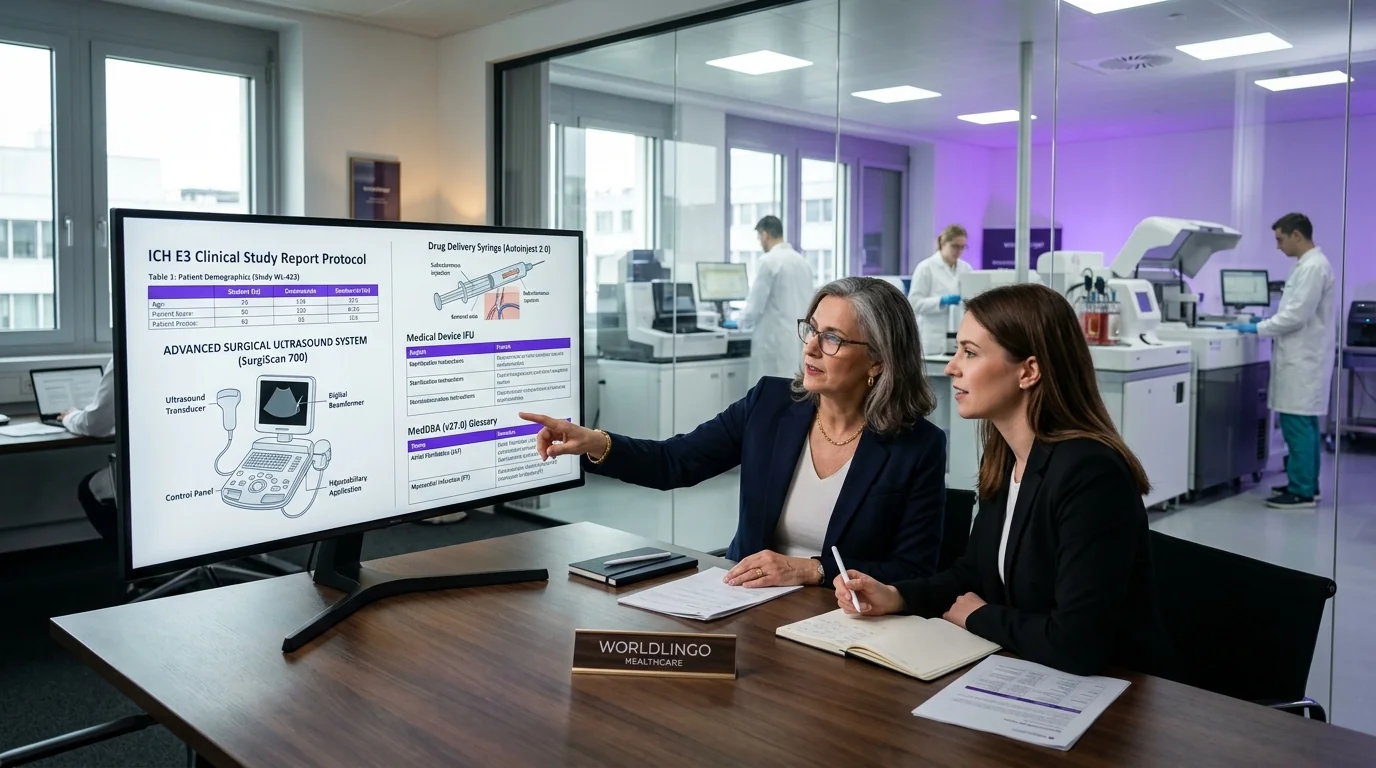
Medical PPT translation covers a wide spectrum: clinical trial protocols, investigator meeting presentations, sales training decks, and patient education slides. Each demands a different balance of terminological precision, regulatory fidelity, and cultural adaptation.
Four Types of Medical PPTs and Their Translation Strategies
| Type | Typical Content | Key Requirements | Common Pitfalls |
|---|---|---|---|
| Clinical training | Procedures, adverse event handling | Term consistency, procedural accuracy | Ambiguous verbs due to tense shifts |
| Regulatory submissions | Clinical data, CTD summaries | Precise regulatory terms, format compliance | Unexpanded abbreviations, outdated references |
| Patient education | Disease info, medication guidance | Health literacy, cultural sensitivity | Literal translation causing confusion |
| Sales materials | Product benefits, competitor comparisons | Marketing localization, compliance claims | Exaggerated efficacy violating advertising laws |
Terminology Management: The Foundation
The first rule of medical PPT translation: terms must align with approved IFUs and Core Data Sheets. We typically require a terminology base (TB) or at least a reference document. If none exists, the translation team must extract and confirm terms before project kickoff.
A real case: A global training deck for an IVD company had "sensitivity" translated as both "灵敏度" (analytical) and "敏感性" (clinical) in Chinese. The mix-up led trainees to misinterpret product performance.
Actionable advice:
- Build a project-specific glossary, annotating context (e.g., "analytical sensitivity" vs "clinical sensitivity")
- Lock terms in CAT tools to ensure consistency across the deck
- Expand abbreviations (CIOMS, MDR) on first mention
Regulatory Compliance: The Invisible Red Lines
Medical PPTs often cite regulations, clinical guidelines, or adverse event reporting formats. Translation must ensure:
- Regulation names and numbers: EU MDR 2017/745, FDA 510(k) must be cited verbatim, not translated.
- Adverse event terminology: "Serious adverse event" in CIOMS format must match ICH E2A definitions exactly.
- IFU references: If a slide quotes the Instructions for Use, the translation must match the approved IFU verbatim—otherwise it's a deviation.
We once handled a submission deck for Japan's PMDA that quoted "substantial equivalence" from an FDA guidance. The Japanese translation "実質的同等性" is acceptable, but PMDA prefers "実質的同等". We aligned with the client's registration dossier.
Multimedia and Layout: The Engineering Challenge
PowerPoint translation isn't just text replacement. Text boxes, font compatibility, animation timing, and chart labels all need re-adaptation.
- Text overflow: German translations expand by 30%, causing layout breaks. Solution: reserve space or use auto-fit.
- Missing fonts: Chinese text may require font substitution (e.g., Source Han Sans).
- Chart labels: Axis titles, legends, and data labels must be translated while preserving alignment.
For e-learning decks (e.g., SCORM packages), LMS compatibility matters. Metadata (titles, descriptions) in xAPI or SCORM manifests should also be translated to ensure proper tracking.
Quality Assurance: From TEP to Back-Translation
A robust QA workflow for medical PPTs includes:
- Bilingual review: A medically qualified reviewer checks against source.
- Monolingual read-through: Target-language expert ensures fluency.
- Format validation: Verify all text boxes, charts, and notes are complete.
- Back-translation spot checks: For critical safety information (contraindications, warnings).
One client requested back-translation of "warning signs" in a patient education deck. It revealed that "seek immediate medical attention" had been softened to "consult your doctor." Caught early, a potential risk was averted.
Choosing a PPT Translation Company
Not every translation agency can handle medical PPTs. Look for:
- ISO 17100-certified processes
- Translators with medical or life sciences backgrounds
- Terminology management services
- PPT layout and multimedia localization capabilities
- NDA and GDPR/HIPAA compliance
WorldLingo provides end-to-end PPT translation for medical clients—from term extraction and translation to layout and final delivery—under ISO 17100 and ISO 27001. To evaluate your next medical presentation project, contact our localization team for a tailored proposal.
Expanding globally or tackling translation compliance?
ISO 17100 certified. Get instant localization readiness diagnostic & quotation.
Share this article