Medical PDF Translation: Where Format Fidelity Meets Regulatory Compliance
Medical PDF translation is not text swapping. A misplaced table row in an IFU can stall EU MDR submission. Here is the engineering checklist for format-preserving PDF translation in eCTD and IFU localization.

One Misaligned Table Row Can Sink a Regulatory Submission
Last year a device manufacturer's EU MDR technical file got flagged by a notified body. The clinical data was solid. The problem? A German IFU PDF where the units column in a table had shifted one row down. The reviewer marked it "not acceptable."
That's the reality of medical PDF translation. It's never just replacing English with German. It's a three-way tug-of-war between format fidelity, terminology consistency, and regulatory compliance.
Why PDF Is the Hardest Format in Translation Engineering
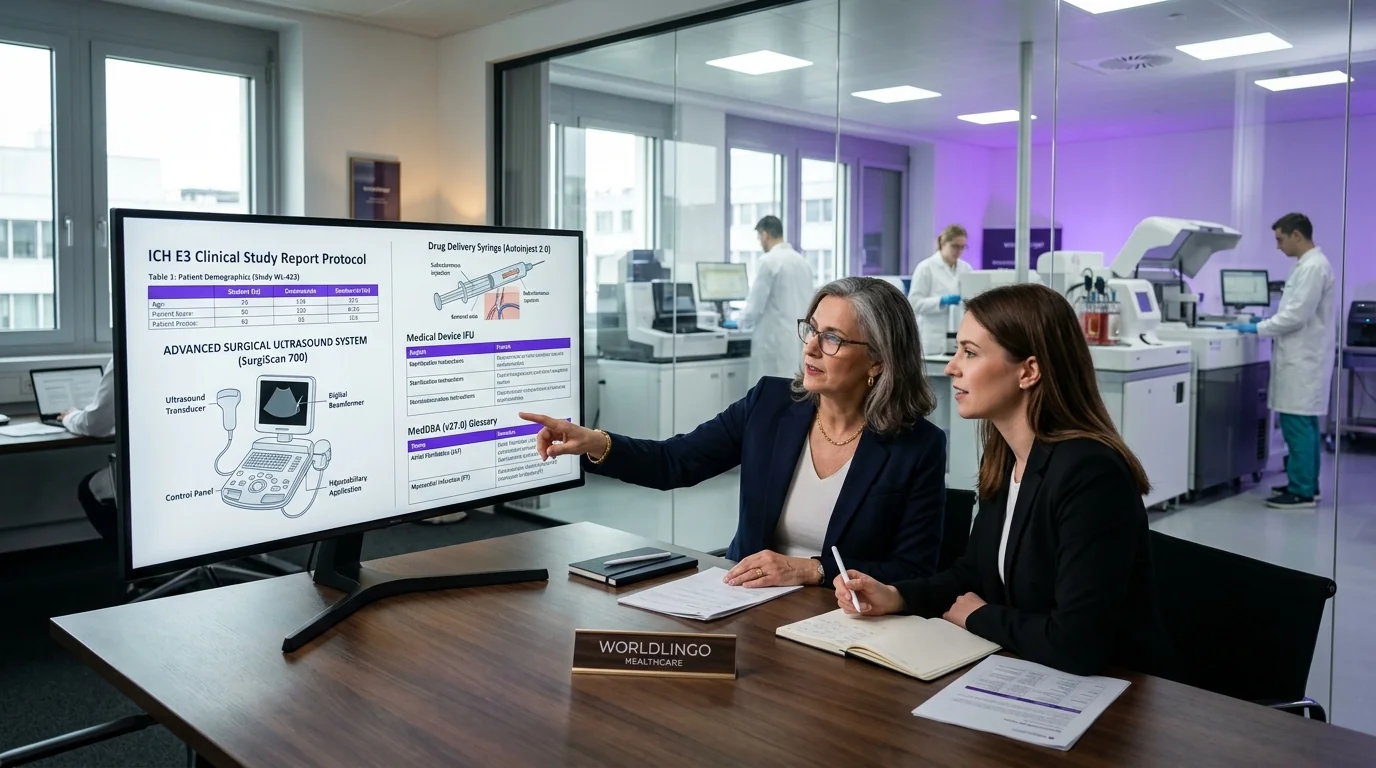
PDF was designed for print fidelity, not structured data. When you translate a PDF document, the logical relationships between text flow, tables, headers, footers, footnotes, and figure captions must be manually reconstructed.
Medical documents make this worse:
- eCTD submissions: FDA and EMA require strict PDF/A compliance, bookmark hierarchy, and functional hyperlinks. Any metadata loss after translation can trigger a technical rejection.
- IFU (Instructions for Use): EU MDR 2017/745 Annex I, Chapter 23 mandates language acceptability, with symbols and warnings in exact positional correspondence to the source.
- Clinical Study Reports (CSR): Cross-page table breaks and statistical symbols (±, ≤, α) are prone to font embedding failures after translation.
We once handled a clinical evaluation report with nested tables and three embedded fonts. One font had no Chinese glyphs. A naive text replacement turned every Greek letter into a box. The fix was rebuilding the font subset, then reflowing paragraph by paragraph.
The Engineered Path to Format-Preserving Translation
Running OCR or a converter on a medical PDF is a form of self-sabotage. Our standard workflow has four stages:
Stage 1: PDF Dissection and Structure Mapping
Using tools like Adobe Acrobat Pro's accessibility checker or pdfplumber, we extract the text layer, image layer, and vector graphics layer. Every translatable text block is tagged with coordinates, font, size, and alignment. The output is a structure map, not a translation.
Stage 2: Terminology and TM Lockdown
Terminology consistency in medical PDF translation is a regulatory issue. "Adverse event" must map to "不良事件" in CIOMS reports, never "副作用." Before kickoff, we pull high-frequency terms from the client's historical eCTD files, MedDRA, and corporate glossaries to build a project-specific termbase.
Counterintuitive lesson: bigger termbases are not better. Beyond 5,000 entries without scenario layering, translators start misapplying terms. We manage three layers: regulatory, clinical, and device-specific.
Stage 3: Layout Reconstruction and Backfill
This is the core of PDF layout translation. We align source and target segments in a CAT tool (Trados or memoQ), export to a layout-preserving format (DOCX or IDML), and have a desktop publishing engineer manually adjust column widths, line spacing, and hyphenation. Chinese runs 20–30% shorter than English, so rebalancing is mandatory to avoid gaping white space.
Stage 4: Format Validation and Compliance Check
No delivery without this checklist:
| Check | Standard | Tool Example |
|---|---|---|
| PDF/A compliance | ISO 19005-1 | veraPDF |
| Bookmarks & hyperlinks | Match source | Acrobat Pro |
| Font embedding | Complete subsets | Preflight |
| Table breaks | No content split | Manual review |
| Terminology consistency | ≥98% termbase match | QA Distiller |
Common Failure Points in Medical PDF Translation
Failure point 1: Hidden header/footer text. Many PDFs carry document IDs and version numbers in headers. Translators miss them. Notified bodies don't.
Failure point 2: Figure captions vs. in-image text. Annotation text baked into radiology images requires image localization, not text-layer translation.
Failure point 3: Symbols and units. Characters like μg, °C, and ± can break when font fallback kicks in. Verify Unicode mapping character by character.
How to Vet a PDF Translation Vendor
Don't just compare quotes. Ask three questions:
- Do you have a medical termbase and qualified translators? (ISO 17100 requires domain competence.)
- What tooling do you use for format validation after PDF layout translation?
- Can you deliver PDF/A output for eCTD?
If the answers are vague, walk away.
Medical PDF document translation has near-zero tolerance for error. A layout mistake in an IFU can delay market entry by months. A format issue in a CSR can trigger a regulatory query. Treat PDF translation as an engineering problem, not a language problem.
Want a feasibility assessment on your medical PDF? Our team can run a sample test at no cost.
Expanding globally or tackling translation compliance?
ISO 17100 certified. Get instant localization readiness diagnostic & quotation.
Share this article