
Medical Device Manual Translation: The Compliance and Engineering Reality
Medical device manual translation is not a language task—it is a regulatory gate. From EU MDR 2017/745 IFU requirements to terminology consistency and version control, here is what actually goes wrong and how to fix it.

Medical Device Manual Translation: The Compliance and Engineering Reality
A infusion pump client called us last year. Their product manual was stuck at German customs. The problem was not a wrong technical spec. It was one sentence in the IFU: “check the tubing regularly” had been translated as “regelmäßig prüfen,” and the notified body argued that the German phrasing failed to specify a check interval, violating Annex I, Section 23 of EU MDR 2017/745 on clarity of intended use and instructions. One sentence. Three weeks of detention.
That is the daily reality of medical device manual translation. It is never just “translate Chinese into English.”
The Regulatory Red Lines: What MDR and IVDR Actually Demand
EU MDR 2017/745 Annex I, Section 23.4 is explicit: instructions for use must be provided in the official language(s) of the target market, and terminology must be understood by the intended user. IVDR 2017/746 imposes similarly strict requirements on IVD labeling and IFU. In the US, FDA 21 CFR 801.5 requires labeling to contain “adequate directions for use.”
Translated into engineering terms, these clauses create three hard constraints:
- Full language coverage: 24 official EU languages. Sell into a country, provide its language. No exceptions.
- Traceable terminology: The same component must carry the same name across the operation manual, service manual, and product catalog.
- Controlled versions: When the manual is revised, every language version updates in sync, and obsolete copies are recalled with a paper trail.
Most companies fail the third one. The Chinese version changes the meaning of an alarm code; the English version lags. A field engineer troubleshoots using the old logic. That is not a translation failure. It is a configuration management failure.
Product Catalog and Specification Sheet Translation: The Underestimated Documents
Product catalogs and specification sheets often get treated as marketing collateral and handed to an ad agency for a quick turn. In medical devices, that is dangerous.
A catalog contains controlled data: dimensions, weight, compatible consumable model numbers, sterilization methods. “Can be autoclaved” is fine. But if the source says “can be repeatedly autoclaved” and the translator drops “repeatedly,” a customer might reprocess a single-use device.
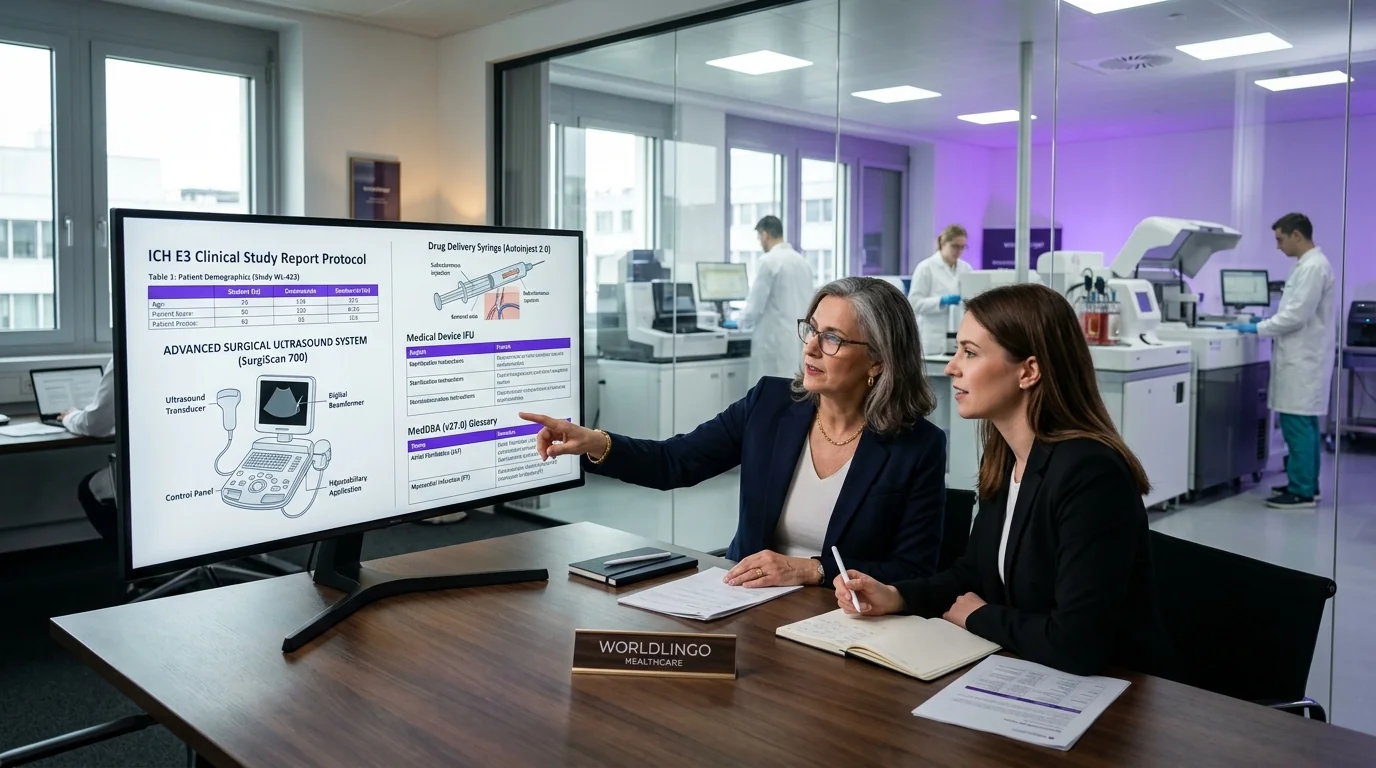
Specification sheet translation is even less forgiving. Unit conversions, tolerance statements, test standard references (e.g., ISO 10993-1)—one wrong digit can trigger a recall-level event. Our rule: product catalog and specification sheet translation must be handled by life-science-trained translators and pass a mandatory second-person technical review.
Terminology Management: The Foundation of Product Documentation Consistency
Product documentation translation spans a wide range—from promotional brochure translation to training decks, from packaging labels to website content. Without a terminology database, consistency is wishful thinking.
We build three terminology assets for every medical device client:
- Regulatory termbase: Terms pulled directly from MDR, IVDR, and FDA source texts. No invented vocabulary.
- Component glossary: Official translated names for every part and UI button, anchored to images.
- Prohibited-terms list: Absolute claims like “cures” or “no side effects” are flagged and replaced with compliant phrasing in promotional brochure translation.
A termbase is not a one-and-done deliverable. Every manual revision triggers a termbase update and a full-database consistency check. Two hours of work. It blocks 80% of cross-document terminology drift.
Compliance Landmines in Promotional Brochure Translation
Promotional brochure translation is where trouble concentrates. Sales teams love “most advanced,” “zero risk,” “completely eliminates.” In medical devices, those phrases can violate MDR Article 7 on misleading claims in the EU and trigger FDA false-labeling enforcement in the US.
Our approach is compliance softening:
- “Most advanced” → “uses current mainstream technology”
- “Zero risk” → “no serious adverse events observed in clinical trials”
- “Completely eliminates” → “effectively improves” (with clinical data citation)
This is not wordplay. It is regulatory requirement. Translators must know where the line sits.
Multilingual Version Control: The Recurring Trap
Manual translation’s most insidious risk is version control. Chinese V3.2 is released. English sits at V3.0. French just updated to V2.8. Field service engineers carry a patchwork of versions.
Our engineering approach:
- Source files managed in structured authoring tools (e.g., DITA XML) with modular content.
- Every language version carries a unique version number and effective date, printed on the back cover.
- Translation memory bound to source version; outdated segments auto-flagged for review.
- Delivery includes a version cross-reference table, signed off by the client’s quality department.
It is not glamorous. It works. ISO 17100:2015 itself includes requirements for version control and project management. Follow the standard.
A Practical Pre-Flight Checklist
If you are scoping a medical device manual translation project, run these five checks before kickoff:
- Is the target-market language list complete (including regional variants like Canadian French)?
- Does the termbase cover regulatory terms, component names, and UI strings?
- Is the source file frozen, and is the change-control process defined?
- Do translators have life-science backgrounds or documented domain experience?
- Does the deliverable include a version cross-reference table and consistency report?
Any question mark means elevated project risk.
Closing Note
In medical devices, manual translation is not a cost line. It is a market-access line. A compliant, accurate, terminology-consistent manual helps you avoid a notified-body nonconformity, a customs hold, or a field error.
If you have product manuals, catalogs, or brochures that need multilingual rollout, send us the source files and target-market list. The Linguist team can map a terminology strategy and version-control plan under ISO 17100 processes—before anything gets translated.
Expanding globally or tackling translation compliance?
ISO 17100 certified. Get instant localization readiness diagnostic & quotation.
Share this article