Why Simultaneous Interpreting Requires Two Interpreters: Cognitive Load and Rotation
Why does simultaneous interpreting require two interpreters? This article explains cognitive load, ISO 17100 quality management, and rotation mechanisms to help you plan interpreter staffing for international conferences.
Introduction: The Staffing Question Behind Every Multilingual Event
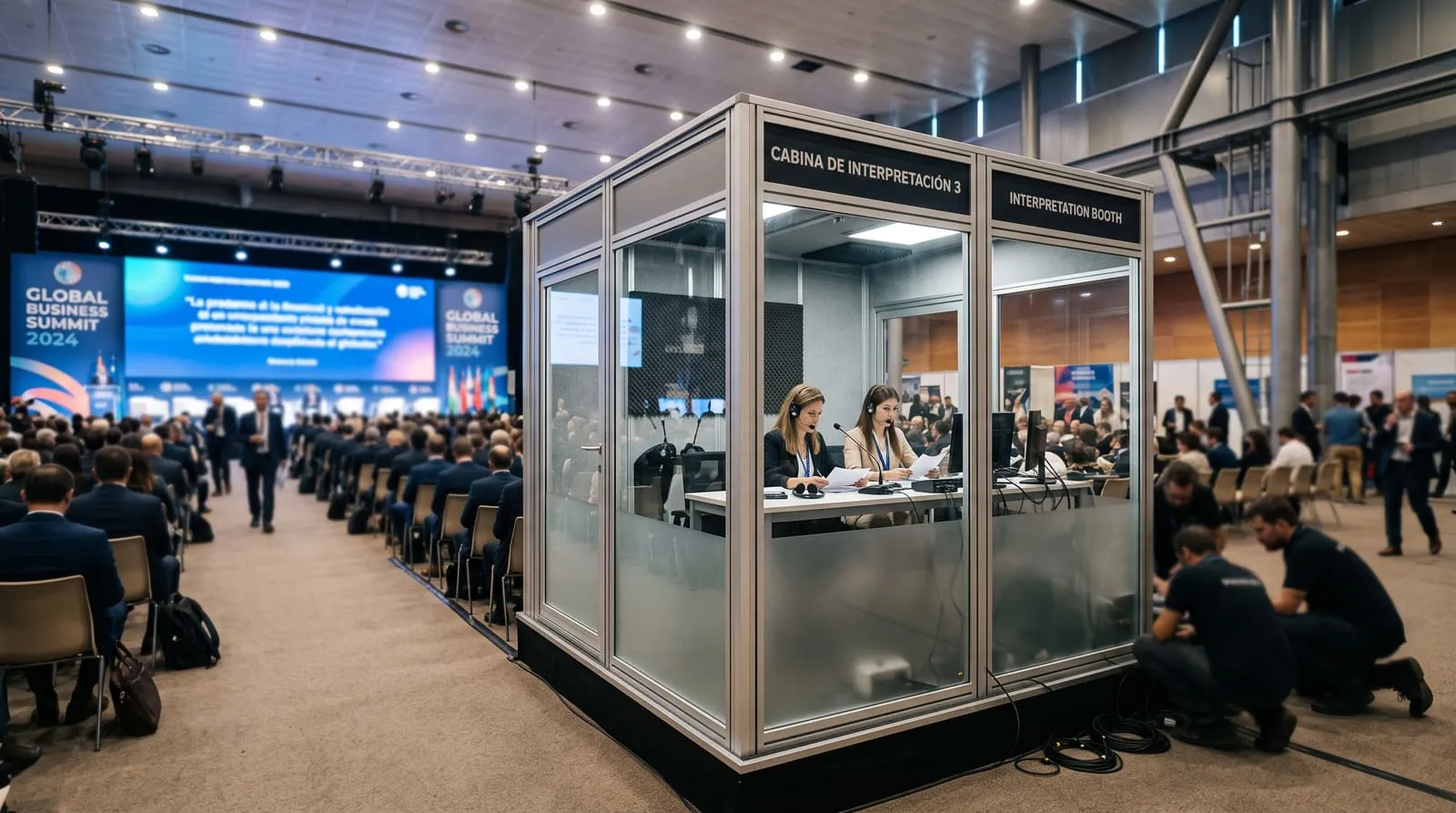
Organizers of international conferences, roadshows, and hybrid webinars often ask: why does simultaneous interpreting require two interpreters? If one highly skilled interpreter is available, why not use that person for the entire session? The answer is not about individual competence. It is about the cognitive limits of the human brain and the quality-management requirements of professional interpreting.
Simultaneous interpreting (SI) requires interpreters to listen to the source language while simultaneously comprehending, converting, and producing the target language. This parallel processing model continuously consumes working memory and executive control resources. Once sustainable capacity is exceeded, error rates, omissions, and processing delays rise sharply. Two-interpreter rotation is therefore not a convention but an engineered safeguard rooted in cognitive science and quality management.
Cognitive Load: Why Two Interpreters Are Needed
Competition for Cognitive Resources
SI involves listening, semantic parsing, discourse prediction, target-language generation, and self-monitoring. According to multiple-resource theory, when tasks compete for the same cognitive resources, performance degrades. After roughly 30 minutes, interpreters typically show fatigue effects such as terminology errors, number misinterpreting, and fluency breakdowns.
The Fatigue Curve and Quality Threshold
Practice and research generally place the optimal focus window for simultaneous interpreters at 20 to 30 minutes. Beyond that window, interpreters must exert additional effort to maintain quality, yet error rates still climb. Rotating two interpreters at 15 to 30 minute intervals allows each to cycle between output and recovery, sustaining consistent language quality across a full event.
Rotation Mechanics: How Interpreter Rotation Works
Standard Rotation Cadence
| Event Duration | Recommended Interpreters | Rotation Interval | Notes |
|---|---|---|---|
| ≤1 hour | 2 | 20–30 min | One active, one monitoring and preparing |
| 1–3 hours | 2 | 15–30 min | Standard configuration for most conferences |
| 3–6 hours | 2–3 | 15–20 min | Add a third for high-intensity agendas |
| >6 hours or technical | 3 | 10–20 min | Medical, patent, legal, and other high-risk content |
The Monitoring Interpreter Is Not Resting
The inactive interpreter typically monitors delivery, verifies terminology, double-checks numbers, and stands by for emergency takeover. This two-person collaboration model significantly reduces the risk of misinterpreting critical data such as dosages, financial figures, and patent numbers. It also aligns with the quality-management principles of ISO 17100:2015.
Interpreter Staffing: Key Variables That Shape Configuration
Content Complexity
Medical conferences involve regulatory terminology such as EU MDR 2017/745, IVDR 2017/746, and CTD/eCTD submissions. Automotive events involve ISO 26262 functional safety, CAN/LIN bus communications, and EV telemetry. Legal and patent proceedings involve PCT international patent applications and cross-border litigation e-Discovery. The higher the terminology density, the greater the cognitive load, and the shorter the rotation interval or the larger the team should be.
Language Direction and Speech Rate
Bidirectional interpreting (e.g., Chinese-English) imposes a higher load than unidirectional interpreting. When speakers exceed 150 words per minute, use large amounts of spontaneous content, or speak with heavy accents, interpreter fatigue accelerates and additional staffing is advisable.
Technical Conditions
Remote simultaneous interpreting (RSI) platforms, hybrid meetings, and multi-language channels add auditory and operational burden. Two interpreters remain the minimum configuration, and three are recommended for technically intensive events.
Configuration Checklist
- Confirm total event duration and agenda density
- Identify high-terminology segments (medical, patent, financial, engineering)
- Confirm language direction and speaker speech rates
- Assess RSI or hybrid meeting technical complexity
- Schedule rotations at 15–30 minute intervals with emergency backup
- Provide glossaries, scripts, and reference materials to reduce cognitive load
- Assign a quality-monitoring and terminology-consistency owner
核心专业术语双语对照表 (Key Terminology Cross-Reference)
| English | Chinese | Definition |
|---|---|---|
| Simultaneous Interpreting (SI) | 同声传译 | Interpreting mode in which the interpreter renders the target language almost simultaneously with the source speech |
| Cognitive Load | 认知负荷 | The demand a task places on working memory and attentional resources |
| Working Memory | 工作记忆 | A limited-capacity system for temporarily storing and processing information |
| Interpreter Rotation | 译员轮换 | A collaboration mechanism in which two or more interpreters alternate output at set intervals |
| Relay Interpreting | 接力口译 | Interpreting through an intermediate language |
| Remote Simultaneous Interpreting (RSI) | 远程同声传译 | Simultaneous interpreting delivered via cloud-based platforms |
| ISO 17100:2015 | ISO 17100:2015 | International standard for translation service quality management |
| Terminology Management | 术语管理 | The process of standardizing, verifying, and maintaining specialized terminology |
Frequently Asked Questions (FAQ)
Why can't one interpreter handle the entire session?
Simultaneous interpreting requires parallel processing of listening, comprehension, and output, which continuously consumes working memory. Prolonged solo output increases error rates, especially for numbers, terminology, and regulatory clauses. Two-interpreter rotation is the baseline configuration for quality and stability.
How do two interpreters divide responsibilities?
Typically one interpreter is active while the other monitors, prepares terminology, and verifies numbers, rotating every 15 to 30 minutes. For high-complexity segments, the interval can be shortened and a third interpreter can be placed on standby.
Are two interpreters still needed for online meetings?
Yes. Remote simultaneous interpreting adds auditory and platform-operation burden, so cognitive load does not decrease. Two interpreters remain the minimum configuration, and three are recommended for technically intensive meetings.
Conclusion: Treat Interpreter Staffing as a Quality-Management Decision
The question of why simultaneous interpreting requires two interpreters is fundamentally an engineering problem of cognitive resources and quality management, not a matter of adding headcount. Appropriate interpreter numbers and rotation mechanisms significantly reduce terminology errors, number misinterpreting, and compliance risk. If you are planning an international conference, medical, or engineering interpreting project, contact WorldLingo for interpreter resource planning and a quote.
Expanding globally or tackling translation compliance?
ISO 17100 certified. Get instant localization readiness diagnostic & quotation.
Share this article