TMS/CAT API Pipeline Integration
Architected for global digital products, SaaS platforms, and enterprise e-commerce.
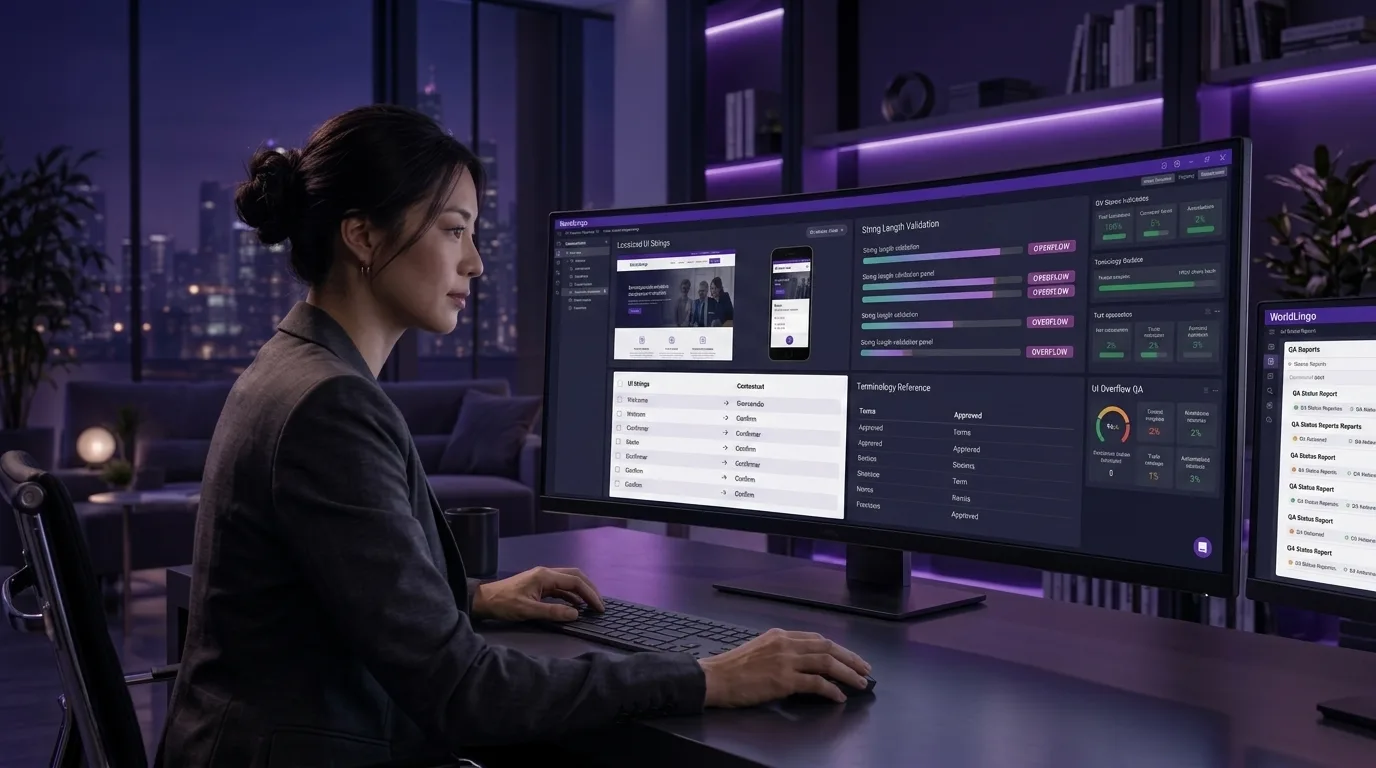
TMS & API Integration: Automated CI/CD Pipelines and Real-Time Content Synchronization
Manual copy-pasting of strings between content management systems, developer codebases, and localization vendors is the single greatest cause of release bottlenecks and broken placeholders in agile software development. Modern continuous delivery demands frictionless, real-time synchronization where updated strings flow automatically to linguists and return merged into production branches without human overhead.
Linguist provides dedicated localization solution architects who handle end-to-end connector configuration, placeholder protection for ICU plurals and XLIFF tags, and staging environment validation. All integrations are built with idempotent designs and message queuing for high-concurrency resilience, secured by OAuth 2.0 and AES-256 encryption.
- ✓ Connectors for Crowdin, Phrase, Lokalise, memoQ and custom TMS platforms
- ✓ ICU plural rules, placeholder protection and XLIFF tag integrity enforcement
- ✓ Idempotent design + message queuing for high-concurrency pipeline stability
- ✓ OAuth 2.0 + AES-256 end-to-end encryption with VPC private network deployment
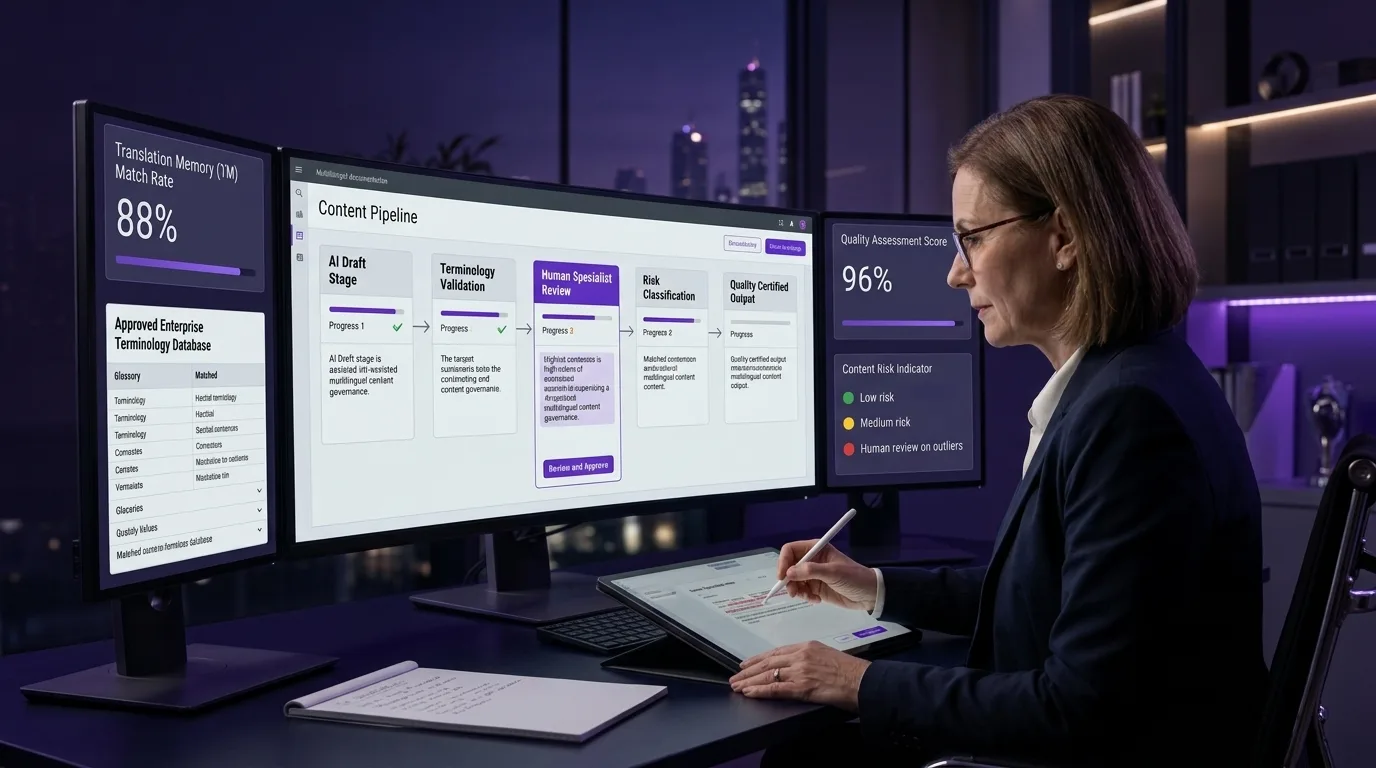
Eliminating 'Spreadsheet Chaos': Why Agile Global Products Need Continuous Localization
In traditional localization workflows, engineering and product teams manually extract interface strings into spreadsheets days before a release, emailing them to external agencies. Linguists translate disconnected text, and developers manually paste translations back into repository resource files. This archaic methodology inevitably introduces catastrophic errors: accidental syntax corruption, missing placeholders, and mismatched keys—all while imposing multi-week delays that paralyze agile release cycles. Continuous Localization eliminates this friction entirely. By connecting source repositories, CMS platforms, and modern TMS systems via resilient API pipelines, string updates trigger automated extraction, translation dispatch, QA validation, and automated pull requests—enabling multi-market feature parity on launch day.

Technical Engineering Hurdles: ICU Plurals, Token Isolation, and Pseudo-Localization
Integrating codebases with a TMS requires far deeper technical sophistication than basic HTTP requests: • **Token & Variable Isolation**: Modern frameworks employ diverse placeholder formats (`%s`, `{count}`, `${user}`). Connectors must encapsulate these variables into immutable tags to prevent linguists from corrupting runtime code. • **ICU Pluralization Logic**: Languages handle pluralization with wildly disparate grammars (Arabic requires six plural categories; Russian requires three). Connectors must natively parse and reconstruct ICU MessageFormat strings to prevent grammatical flaws. • **Automated Pseudo-Localization**: Before dispatching strings to human translators, the CI pipeline generates pseudo-localized builds with accented character expansion (`[Àpplîcätîön !!!]`), immediately exposing hardcoded strings and UI layout truncation in automated UI regression tests.

Resilient Architecture: Idempotency, Rate Limiting, and Enterprise Data Security
For enterprise platforms handling continuous content updates, localization integration architectures must guarantee high availability and fault tolerance. Linguist's integrations enforce strict idempotency: network timeouts or duplicate webhook deliveries never trigger double billing or duplicate tasks. Built-in asynchronous message queues and rate-limiting buffers smoothly absorb traffic spikes during major marketing blitzes. On the security front, we employ OAuth 2.0 authentication, end-to-end TLS 1.3 encryption, and support VPC peering—ensuring that your pre-release code and confidential commercial assets remain completely secure.

Enterprise Delivery Standards & Deliverables
Every specialized service includes full format fidelity, language asset retention, and end-to-end quality traceability.
Final Work Products
Full layout and visual hierarchy preservation across all file formats
- ✓ Format-Preserved Translations (Office/PDF/InDesign)
- ✓ Bilingual Side-by-Side Review Files
- ✓ Production-Ready Deployment Packages
Language Assets Package
Deliverables include durable digital assets for enterprise scale
- ✓ Enterprise TermBases (TB / Glossary)
- ✓ Standard Translation Memories (TMX / XLIFF)
- ✓ Do-Not-Translate & Brand Tone Guidelines
Quality & Compliance Proof
Meeting international regulatory and legal audit standards
- ✓ ISO 17100 Traceability Card & Sign-Off Report
- ✓ Official Certified Translation Certificate / Seal
- ✓ Strict Confidentiality Undertaking & NDA Compliance
SLA & Post-Delivery Support
Ongoing warranty to guarantee seamless business launch
- ✓ 30-90 Days Post-Delivery Revision Warranty
- ✓ Pre-Launch Testing Coordination & Fixes
- ✓ Dedicated Project Manager & Lead Linguist Support
Specific Scope Deliverables
Depending on scope, we can deliver the following and integrate with your toolchain:
TMS Integration & Implementation Roadmap
From scope alignment through acceptance—clear quality gates and PM oversight.
Architecture Audit & Scope Analysis
Examine code repositories, CMS stacks, and deployment workflows to formulate an engineering blueprint covering API endpoints, auth, and retry policies.
API Connector Development & Data Mapping
Develop lightweight middleware or GitHub Actions scripts to execute string extraction, tag isolation, metadata injection, and bidirectional mapping.
Sandbox Staging & Pseudo-Localization
Run end-to-end pseudo-localization in staging environments to validate string expansion, UI truncation, special character handling, and back-propagation.
Canary Deployment & Webhook Stress Testing
Pilot automated workflows on non-critical branches or pilot languages, validating latency, rate-limiting handlers, and failure notification triggers.
Production Release & 24/7 SLA Operations
Deliver complete architectural documentation, source repositories, and operational playbooks, backed by continuous monitoring and API maintenance.
Why Choose Linguist for TMS API Integration
Zero-Touch Continuous Localization
Eliminate manual spreadsheet handoffs between developers and translators; strings flow autonomously from commit to global production.
Localization Engineering Meets Modern DevOps
Our team pairs localization engineers with veteran DevOps architects fluent in GitOps, containerization, REST/GraphQL, and cloud-native stacks.
Broad Ecosystem Interoperability
Turnkey connectivity across GitHub, GitLab, Bitbucket, Contentful, Strapi, Zendesk, Lokalise, Phrase, Crowdin, and Trados Enterprise.
Enterprise Resiliency & Security
Engineered with OAuth 2.0 auth, end-to-end data encryption, automated exponential backoff, and idempotent queue processing for high-volume scale.

Related AI Localization & Quality Automation Specializations
Explore adjacent specialized capabilities within the same enterprise domain.
Machine Translation Post-Editing (MTPE)
Empower high-volume enterprise documentation, technical support knowledge bases, and e-commerce catalogs by combining state-of-the-art Neural Machine Translation (NMT) engines with certified native linguists—drastically slashing turnaround times and localization budgets.
LLM Prompt Localization & Cultural Tuning
Engineered for international AI products, multilingual conversational agents, and generative applications. Blending prompt engineering with cross-cultural pragmatics to resolve semantic drift, token bloat, and hallucinations across global markets.
AI Output Review & Human Compliance
Expert human-in-the-loop review and editing for enterprise multilingual AIGC marketing copy, technical documentation, legal inquiries, and product descriptions. Eliminate hallucinations, verify facts, enforce regulatory compliance, and restore native brand voice.
Terminology & Translation Memory Governance
Resolve historical terminology sprawl, translation memory (TM) corruption, and conflicting multilingual assets across global teams. Leveraging advanced NLP algorithms and accredited terminologists to construct high-leverage enterprise linguistic knowledge bases.
AI Quality Scoring & MQM Evaluation
Move beyond subjective opinions with empirical, objective data. Leveraging the Multidimensional Quality Metrics (MQM) framework and state-of-the-art reference-free Quality Estimation (QE) models to deliver quantifiable, transparent quality telemetry across all your language vendors.
Frequently asked questions
Common questions on pricing, turnaround, confidentiality and file formats—contact us for anything else.
Ready to Start Your Project?
Submit your requirements and files. Our consultant will provide a transparent quote and timeline within 24 hours.
What is included in TMS & API Integration?
How much does TMS & API Integration (AI Localization & Quality Automation) cost?
What factors affect translation pricing?
How long does translation take?
Can you handle urgent projects?
Do you sign NDAs and protect confidential files?
Ready to Start Your Project?
Submit your requirements and files. Our consultant will provide a transparent quote and timeline within 24 hours.
Ready to start your tms & api integration project?
Automated pipelines connecting Crowdin, Phrase, custom CMS and Git repos.