AI Quality Scoring & MQM Evaluation
Move beyond subjective opinions with empirical, objective data.
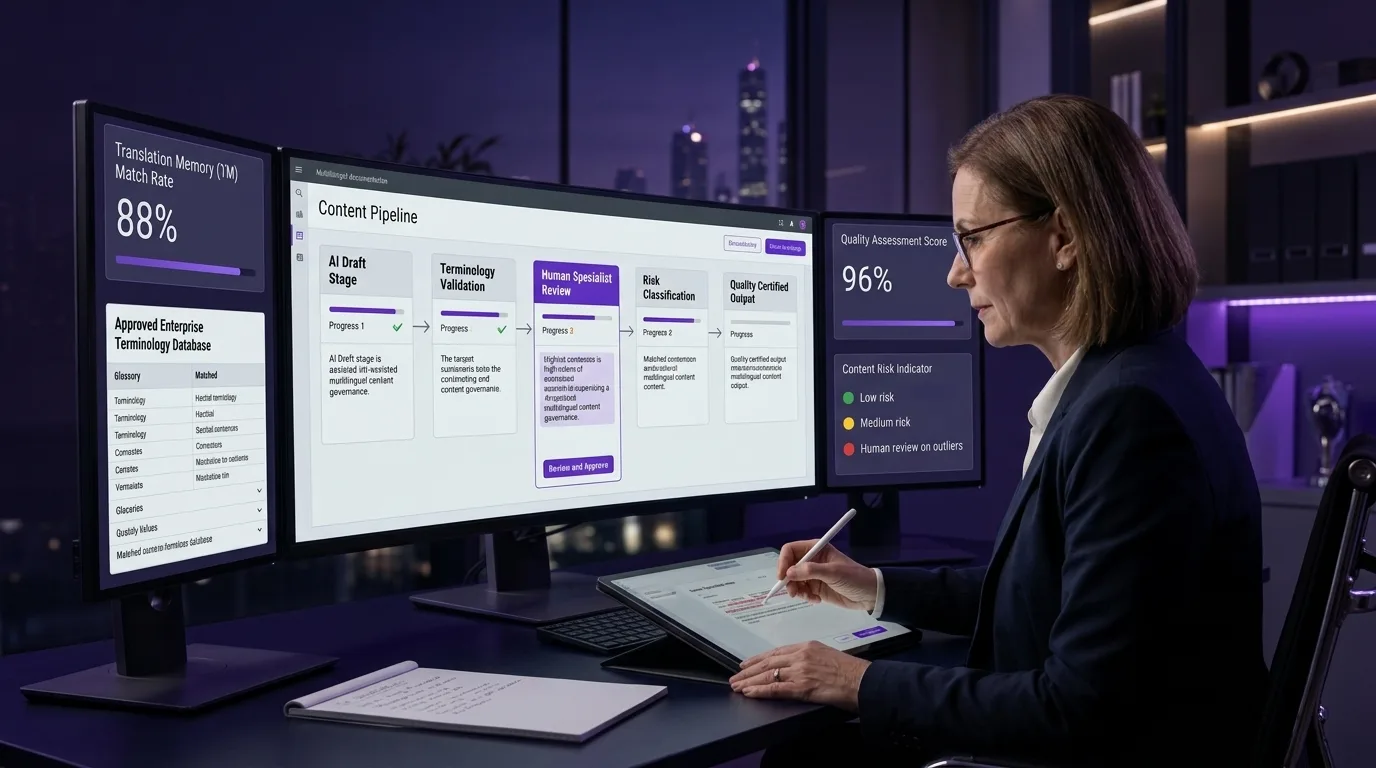
Quality Scoring Framework: Objective MQM Error Metrics and Dynamic Evaluation Calibration
Subjective feedback like 'this doesn't sound natural' is impossible to audit, manage, or improve at enterprise scale. Transforming global localization into a predictable, data-driven operation requires standardized, multidimensional error taxonomies that quantify linguistic defects according to severity, category, and direct impact on the end-user experience.
Linguist builds custom multi-dimensional quality dashboards that combine MQM / ISO 5060 error taxonomies with BLEU and COMET-QE automated metrics, calibrated against structured human spot-checks. Real-time low-score segment interception prevents quality issues from reaching downstream workflows, while error-type distribution reports drive continuous glossary and source-copy optimization.
- ✓ MQM / ISO 5060 multi-dimensional error taxonomy with weighted severity scoring
- ✓ BLEU / COMET-QE automated metrics + structured human evaluation dual track
- ✓ Real-time low-score segment interception before downstream pipeline release
- ✓ Error-type distribution reports driving glossary and source-copy optimization loops

Moving Beyond 'Gut Feeling': How MQM Establishes Objective Standards
Historically, multinational organizations have struggled with subjective debates when reviewing localized content: regional sales teams complain that a translation 'lacks flavor,' while translation vendors insist the text is 'faithful to the source.' Without quantifiable standards, resolution devolves into subjective haggling. MQM (Multidimensional Quality Metrics) represents the definitive scientific framework developed by the international localization industry (now codified in ISO 5060). MQM breaks translation quality down into an exhaustive taxonomic tree: Accuracy (Addition, Omission, Mistranslation), Fluency (Grammar, Punctuation, Spelling), Terminology (Inconsistency, Non-Conformance), and Locale Conventions. Defect severity tiers carry mathematically calibrated penalty weights (e.g., Critical = 10, Major = 5, Minor = 1). The result is an objective defect rate per thousand words and a standardized percentage score, banishing subjectivity from quality governance.

AI-Powered Quality Estimation: Real-Time Governance Without References
Traditional algorithmic evaluation metrics require a human-authored gold reference translation to compute scores like BLEU. Yet in enterprise production—such as customer support chats, daily social updates, and continuously updating product catalogs—reference translations simply do not exist. COMET-QE (Quality Estimation) leverages cross-lingual transformer embeddings to evaluate raw machine translation output directly against the source text without needing reference translations. By analyzing semantic divergence, linguistic cohesion, and token alignment, COMET-QE produces accurate predictive quality scores in milliseconds. Linguist integrates QE directly into production pipelines, automatically isolating high-risk segments before they ever reach customers.

From Defect Hunting to Strategic Optimization: The Quality Telemetry Loop
The ultimate objective of quality evaluation is not punitive vendor governance, but systematic organizational intelligence. Through Linguist's executive quality dashboards, enterprise stakeholders gain comprehensive visibility into operational trends: Which locales suffer from chronic terminology inconsistency? Are defects caused by source text ambiguities, insufficient prompt constraints, or vendor staffing churn? By conducting forensic Root Cause Analysis (RCA), audit data directly refines style guides, expands central termbases, and guides model fine-tuning. This transforms quality assurance from a cost-center bottleneck into a self-reinforcing, virtuous cycle of continuous localization improvement.

Enterprise Delivery Standards & Deliverables
Every specialized service includes full format fidelity, language asset retention, and end-to-end quality traceability.
Final Work Products
Full layout and visual hierarchy preservation across all file formats
- ✓ Format-Preserved Translations (Office/PDF/InDesign)
- ✓ Bilingual Side-by-Side Review Files
- ✓ Production-Ready Deployment Packages
Language Assets Package
Deliverables include durable digital assets for enterprise scale
- ✓ Enterprise TermBases (TB / Glossary)
- ✓ Standard Translation Memories (TMX / XLIFF)
- ✓ Do-Not-Translate & Brand Tone Guidelines
Quality & Compliance Proof
Meeting international regulatory and legal audit standards
- ✓ ISO 17100 Traceability Card & Sign-Off Report
- ✓ Official Certified Translation Certificate / Seal
- ✓ Strict Confidentiality Undertaking & NDA Compliance
SLA & Post-Delivery Support
Ongoing warranty to guarantee seamless business launch
- ✓ 30-90 Days Post-Delivery Revision Warranty
- ✓ Pre-Launch Testing Coordination & Fixes
- ✓ Dedicated Project Manager & Lead Linguist Support
Specific Scope Deliverables
Depending on scope, we can deliver the following and integrate with your toolchain:
Empirical Quality Assessment & Audit Methodology
From scope alignment through acceptance—clear quality gates and PM oversight.
Metrics Calibration & Threshold Definition
Tailor MQM error penalty weights, severity levels, and Pass/Fail score thresholds based on content visibility, compliance risk, and domain criticality.
Statistically Sound Blind Sampling
Extract representative segment samples using randomized statistical modeling, stripping vendor and translator identifiers to guarantee absolute impartiality.
AI Metric Inference & Native Expert Review
Execute automated neural QE scoring while accredited native domain linguists perform rigorous sentence-level error tagging and typology classification.
Defect Rate Computation & Data Synthesis
Compute composite MQM scores and defect rates per 1,000 words, generating multidimensional visualizations across all evaluated linguistic axes.
Actionable Audit Delivery & Remediation
Deliver an authoritative audit report detailing systemic defect root causes and prescribing concrete enhancements for glossaries, prompts, and workflows.
Why Choose Linguist for AI Quality Evaluation
Eliminate Subjective Debates with Hard Data
Anchor evaluation in international MQM standards and mathematical defect formulas, replacing subjective opinions with incontrovertible metrics.
Dual AI QE Speed and Expert Human Precision
Combine sub-second, million-word automated Quality Estimation with forensic linguistic review by certified native terminologists.
Strictly Independent & Impartial Positioning
As an independent third-party auditor, we hold no bias toward specific engines or translation agencies, providing management with unvarnished truth.
Continuous Localization Asset Optimization
Turn audit findings into strategic assets: error patterns directly inform termbase enrichments, prompt calibrations, and model fine-tuning.

Related AI Localization & Quality Automation Specializations
Explore adjacent specialized capabilities within the same enterprise domain.
Machine Translation Post-Editing (MTPE)
Empower high-volume enterprise documentation, technical support knowledge bases, and e-commerce catalogs by combining state-of-the-art Neural Machine Translation (NMT) engines with certified native linguists—drastically slashing turnaround times and localization budgets.
LLM Prompt Localization & Cultural Tuning
Engineered for international AI products, multilingual conversational agents, and generative applications. Blending prompt engineering with cross-cultural pragmatics to resolve semantic drift, token bloat, and hallucinations across global markets.
AI Output Review & Human Compliance
Expert human-in-the-loop review and editing for enterprise multilingual AIGC marketing copy, technical documentation, legal inquiries, and product descriptions. Eliminate hallucinations, verify facts, enforce regulatory compliance, and restore native brand voice.
Terminology & Translation Memory Governance
Resolve historical terminology sprawl, translation memory (TM) corruption, and conflicting multilingual assets across global teams. Leveraging advanced NLP algorithms and accredited terminologists to construct high-leverage enterprise linguistic knowledge bases.
TMS/CAT API Pipeline Integration
Architected for global digital products, SaaS platforms, and enterprise e-commerce. Seamlessly interconnect your code repositories (GitHub/GitLab), Headless CMS, and support desks with modern Translation Management Systems (TMS) for automated, zero-touch continuous localization.
Frequently asked questions
Common questions on pricing, turnaround, confidentiality and file formats—contact us for anything else.
Ready to Start Your Project?
Submit your requirements and files. Our consultant will provide a transparent quote and timeline within 24 hours.
What is included in Quality Scoring Framework?
How much does Quality Scoring Framework (AI Localization & Quality Automation) cost?
What factors affect translation pricing?
How long does translation take?
Can you handle urgent projects?
Do you sign NDAs and protect confidential files?
Ready to Start Your Project?
Submit your requirements and files. Our consultant will provide a transparent quote and timeline within 24 hours.
Ready to start your quality scoring framework project?
Automated BLEU/MQM metrics combined with structured human evaluations.