Terminology & Translation Memory Governance
Resolve historical terminology sprawl, translation memory (TM) corruption, and conflicting multilingual assets across global teams.
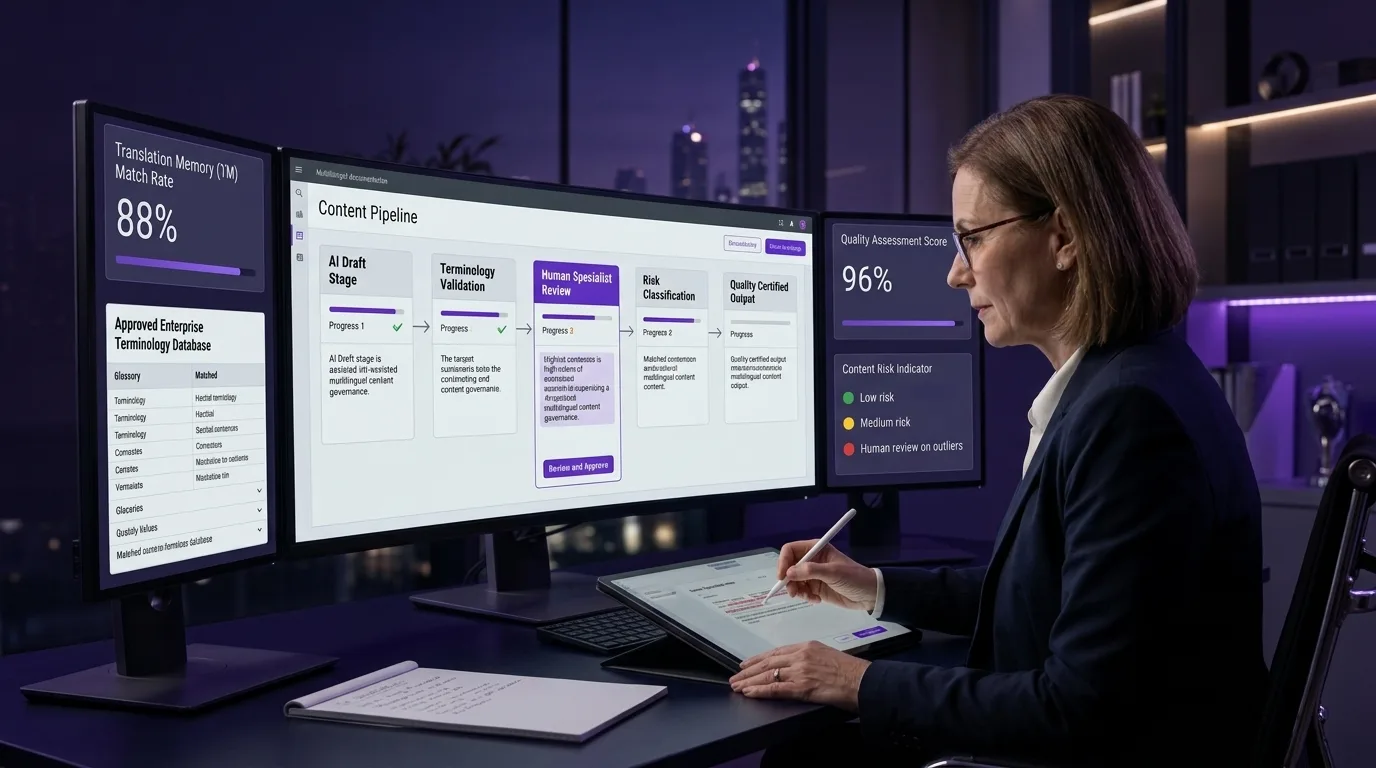
Terminology & TM Governance: Enterprise Corpus Sanitation, Deduplication, and Cross-Engine Alignment
Decades of ad-hoc translations, fragmented vendor deliveries, and outdated bilingual spreadsheets inevitably result in corpus pollution—conflicting product terminology, inconsistent brand voice, and noisy legacy translation memories. When fed into modern CAT tools or used to fine-tune AI translation models, dirty data degrades every subsequent generation and inflates editing costs across all languages.
Linguist performs end-to-end corpus diagnostics, identifying version conflicts, terminology contradictions and format pollution across legacy assets. Clean, standardized TBX/TMX deliverables are platform-neutral and include an AI-training toxicity filter module that prevents contaminated data from entering model fine-tuning pipelines.
- ✓ Full-spectrum corpus audit: version conflicts, terminology drift and format noise removal
- ✓ Platform-neutral TBX / TMX deliverables conforming to ISO 30042 standards
- ✓ Lossless migration support for Trados, Phrase, memoQ and Lokalise
- ✓ AI-training bilingual alignment QA with toxicity and bias filtering module

The Crisis of 'Corpus Pollution': The Hidden Drag on Global Growth
Over years of multinational operations, enterprises inevitably accumulate hundreds of disconnected translation memory (TMX) files and ad-hoc spreadsheets scattered across business units and external vendors. Without centralized governance, these repositories succumb to severe 'corpus pollution': a single proprietary feature is translated into three contradictory terms across documentation; obsolete product names continuously populate fuzzy matches; and broken HTML/XML tags corrupt translation memory databases. This degrades CAT fuzzy match reuse, inflates translation expenses, and produces confusing user experiences. Linguist's industrial corpus governance purges systemic defects, revitalizing enterprise linguistic equity.

TBX & TMX Open Standards: Building Portable, Platform-Agnostic Assets
To avoid vendor lock-in with proprietary commercial CAT or TMS software, strict adherence to international open data standards is essential. Linguist strictly implements the frameworks established by the Localization Industry Standards Association (LISA) and the International Organization for Standardization (ISO), notably ISO 30042 (Terminology Markup Framework - TBX) and TMX (Translation Memory eXchange). Beyond surface linguistic accuracy, we standardize metadata schemas—including author provenance, timestamps, usage context, verification status, and BCP 47 compliant language tags. Sanitized assets export seamlessly across Trados, Phrase, memoQ, Lokalise, and custom enterprise tools.

The New Frontier in AI: Curating Clean Ground Truth for Enterprise LLMs
As multinational enterprises invest in proprietary large language models (LLMs) and custom Neural Machine Translation (NMT), pristine aligned bilingual corpora have emerged as digital gold. Feeding uncleaned legacy translation memories filled with hallucinations, archaic terminology, and structural noise directly into model fine-tuning pipelines corrupts foundation model performance, causing catastrophic generation errors in customer-facing applications. Linguist's governance pipelines feature specialized data curation modules for AI training: toxicity filtering, sentence length normalization, and semantic embedding alignment thresholds—supplying immaculate datasets to empower enterprise generative AI initiatives.

Enterprise Delivery Standards & Deliverables
Every specialized service includes full format fidelity, language asset retention, and end-to-end quality traceability.
Final Work Products
Full layout and visual hierarchy preservation across all file formats
- ✓ Format-Preserved Translations (Office/PDF/InDesign)
- ✓ Bilingual Side-by-Side Review Files
- ✓ Production-Ready Deployment Packages
Language Assets Package
Deliverables include durable digital assets for enterprise scale
- ✓ Enterprise TermBases (TB / Glossary)
- ✓ Standard Translation Memories (TMX / XLIFF)
- ✓ Do-Not-Translate & Brand Tone Guidelines
Quality & Compliance Proof
Meeting international regulatory and legal audit standards
- ✓ ISO 17100 Traceability Card & Sign-Off Report
- ✓ Official Certified Translation Certificate / Seal
- ✓ Strict Confidentiality Undertaking & NDA Compliance
SLA & Post-Delivery Support
Ongoing warranty to guarantee seamless business launch
- ✓ 30-90 Days Post-Delivery Revision Warranty
- ✓ Pre-Launch Testing Coordination & Fixes
- ✓ Dedicated Project Manager & Lead Linguist Support
Specific Scope Deliverables
Depending on scope, we can deliver the following and integrate with your toolchain:
Corpus & Terminology Engineering Workflow
From scope alignment through acceptance—clear quality gates and PM oversight.
Asset Inventory & Health Diagnostic
Scan existing client TMX, Excel, and TBX files to deliver a data health report analyzing corruption rates, duplication, and terminology dissonance.
Algorithmic Hygiene & Deduplication
Execute proprietary sanitization scripts to strip corrupted tags, resolve misaligned pairs, and merge redundant translation units.
Expert Linguistic Adjudication
Subject-matter linguists collaborate with client stakeholders to resolve disputed terms, establish canonical translations, and draft definitions.
Standards Packaging & Validation
Package sanitized corpora into ISO-compliant TMX 2.0 and TBX formats, performing ingestion and indexing tests across leading CAT/TMS platforms.
Cloud Deployment & Ongoing Governance
Deploy pristine assets into the central enterprise TMS, establish automated contamination-prevention guardrails, and conduct periodic health audits.
Why Choose Linguist for Terminology & TM Governance
Revitalize Dormant Digital Assets
Transform chaotic, fragmented legacy translations into pristine, reusable knowledge assets, driving subsequent TM leverage up by over 30%.
NLP Velocity & Human Adjudication
Harness modern deep-learning sanitization algorithms paired with accredited native terminologists to clean millions of words with precision.
Strict Standards Interoperability
Full adherence to ISO 30042 (TBX) and LISA (TMX) schemas, ensuring seamless asset portability across Trados, Phrase, memoQ, and Lokalise.
Foundational AI Training Data
Supply enterprise proprietary LLMs, chatbots, and neural MT engines with pristine, aligned bilingual pairs for flawless domain fine-tuning.

Related AI Localization & Quality Automation Specializations
Explore adjacent specialized capabilities within the same enterprise domain.
Machine Translation Post-Editing (MTPE)
Empower high-volume enterprise documentation, technical support knowledge bases, and e-commerce catalogs by combining state-of-the-art Neural Machine Translation (NMT) engines with certified native linguists—drastically slashing turnaround times and localization budgets.
LLM Prompt Localization & Cultural Tuning
Engineered for international AI products, multilingual conversational agents, and generative applications. Blending prompt engineering with cross-cultural pragmatics to resolve semantic drift, token bloat, and hallucinations across global markets.
AI Output Review & Human Compliance
Expert human-in-the-loop review and editing for enterprise multilingual AIGC marketing copy, technical documentation, legal inquiries, and product descriptions. Eliminate hallucinations, verify facts, enforce regulatory compliance, and restore native brand voice.
TMS/CAT API Pipeline Integration
Architected for global digital products, SaaS platforms, and enterprise e-commerce. Seamlessly interconnect your code repositories (GitHub/GitLab), Headless CMS, and support desks with modern Translation Management Systems (TMS) for automated, zero-touch continuous localization.
AI Quality Scoring & MQM Evaluation
Move beyond subjective opinions with empirical, objective data. Leveraging the Multidimensional Quality Metrics (MQM) framework and state-of-the-art reference-free Quality Estimation (QE) models to deliver quantifiable, transparent quality telemetry across all your language vendors.
Frequently asked questions
Common questions on pricing, turnaround, confidentiality and file formats—contact us for anything else.
Ready to Start Your Project?
Submit your requirements and files. Our consultant will provide a transparent quote and timeline within 24 hours.
What is included in Terminology & TM Governance?
How much does Terminology & TM Governance (AI Localization & Quality Automation) cost?
What factors affect translation pricing?
How long does translation take?
Can you handle urgent projects?
Do you sign NDAs and protect confidential files?
Ready to Start Your Project?
Submit your requirements and files. Our consultant will provide a transparent quote and timeline within 24 hours.
Ready to start your terminology & tm governance project?
Enterprise termbase and TM curation to align human and machine translation.